Email: service@yescot.com
Phone:
North America Office
+1 346 649 1407 (Direct line/SMS)
Headquarters and R&D
+886 2 25429145 (Manufacturing)
Physical address:
RM801. No150. Jilin Rd.
Taipei City, Taiwan.
Website: www.yescot.com

Email: service@yescot.com
Phone:
North America Office
+1 346 649 1407 (Direct line/SMS)
Headquarters and R&D
+886 2 25429145 (Manufacturing)
Physical address:
RM801. No150. Jilin Rd.
Taipei City, Taiwan.
Website: www.yescot.com
We do more than manufacture rubber components. Our engineering approach focuses on how rubber interacts with metal and mechanical springs. We ensure each solution—whether a seismic isolator or a complex breather valve—performs reliably under real operating conditions..
At YESCOT, manufacturing capability is not defined by equipment alone — it is defined by process control, material expertise, and delivery reliability.
We specialize in the manufacturing of rubber components, rubber-to-metal bonded parts, oil seals, custom-molded rubber products, anti-vibration solutions, and springs, supporting a wide range of industrial applications.
To complement these capabilities, we also provide advanced metal CNC machining and multi-material assembly, enabling seamless integration of rubber, metal, and spring components into fully functional systems.
From initial sampling and tooling development to stable mass production, our manufacturing system is designed to support buyers who value precision, consistency, and long-term supply stability.
We work closely with professional buyers, engineers, and quality teams to ensure every component meets functional, dimensional, and durability requirements before entering production.
Our capability structure is designed to help buyers:
If you are looking for a reliable manufacturing partner, not just a supplier, YESCOT is structured to support your project from concept to production.
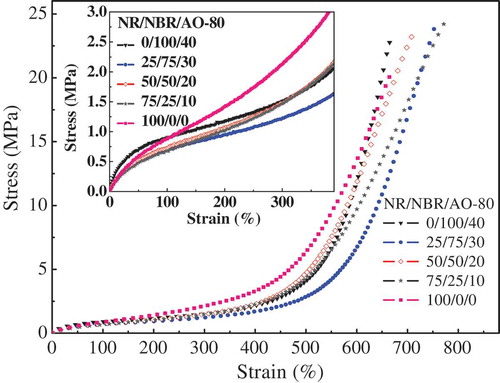
● Engineering Focus: Utilizing the Strain-Induced Crystallization (SIC) characteristic of high-grade Natural Rubber.
● Technical Advantage: Our NR formulations provide exceptional flexibility and high tensile strength (exceeding 20 MPa). While traditional NR has a low equivalent damping ratio (2%-4%), Yescot optimizes the compound to ensure maximum elasticity for general seismic and industrial isolation.
● Application: Ideal for standard motor mounts and building isolators where high flexibility and 70+ years of service life are required.
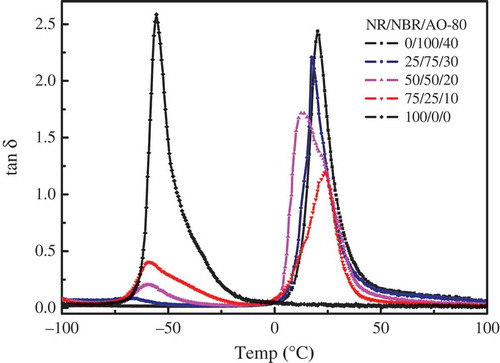
● Engineering Focus: A co-continuous phase composite of NR and NBR/AO-80 hybrid matrix.
● Technical Advantage: By incorporating hindered phenol (AO-80) into the NBR matrix, we achieve a significantly higher loss factor (tan δ > 0.3) within the critical working temperature range of 4.4°C to 36.8°C. This eliminates the need for a lead core (Lead-Rubber Bearings) while providing superior energy dissipation through intermolecular friction.
● Application: Precision equipment protection and high-performance seismic bearings requiring an equivalent damping ratio of 10%–20%.
Table. Relationship between HED and strain of NR/NBR/AO-80 composites.

● Engineering Focus: High-modulus Nitrile Butadiene Rubber (NBR) orientation under stretching.
● Technical Advantage: Our reinforced NBR solutions are engineered for high-stress environments. The simultaneous strain-induced orientation of NBR and crystallization of NR allows the material to handle large deformations (up to 650% elongation) while maintaining structural integrity. These composites exhibit high hysteresis energy, meaning they “eat” shock energy more efficiently than conventional fillers.
● Application: Heavy-duty industrial machinery, oil-resistant vibration pads, and infrastructure-grade shock absorbers.
● Engineering Focus: Synchronizing mechanical spring rates with rubber elastomeric damping.
● Application: Precision Breather Valves, Pressure Regulators, and Custom Transmission Components.
| Material Property | Standard NR | High-Damping (HDR) | Heavy-Load NBR |
| Tensile Strength | $> 20\text{ MPa}$ | $> 15\text{ MPa}$ | $> 22\text{ MPa}$ |
| Max Elongation | $> 600\%$ | $> 500\%$ | $> 650\%$ |
| Loss Factor ($\tan \delta$) | $0.02 – 0.04$ | $> 0.30$ | $0.10 – 0.15$ |
| Working Temp. | $-40^\circ\text{C}$ to $70^\circ\text{C}$ | $0^\circ\text{C}$ to $40^\circ\text{C}$ | $-20^\circ\text{C}$ to $100^\circ\text{C}$ |
| Damping Ratio | $2\% – 4\%$ | $10\% – 20\%$ | $8\% – 12\%$ |
Our production and quality control systems are structured around internationally recognized quality management principles, ensuring consistency, traceability, and continuous improvement across all manufacturing stages. “We bridge the gap between material science and structural safety.” Every solution at Yescot is backed by academic rigor and industrial-grade testing to ensure your project’s longevity and performance.
● Dynamic Mechanical Thermal Analysis (DMTA): We verify the Loss Factor (tan δ) and Storage Modulus across a wide temperature spectrum (-100°C to 100°C) to ensure performance stability in various climates.
● Hysteresis Loss Testing: Our internal lab measures the area enclosed by the stretch and retraction curves to calculate the exact Energy Dissipation Capacity of every custom batch.
● Tensile & Durability Standards: All materials are tested following ASTM D412 standards, ensuring tensile strengths above 20 MPa and superior elongation at break (>650%).
.